Physical Address
304 North Cardinal St.
Dorchester Center, MA 02124
Physical Address
304 North Cardinal St.
Dorchester Center, MA 02124
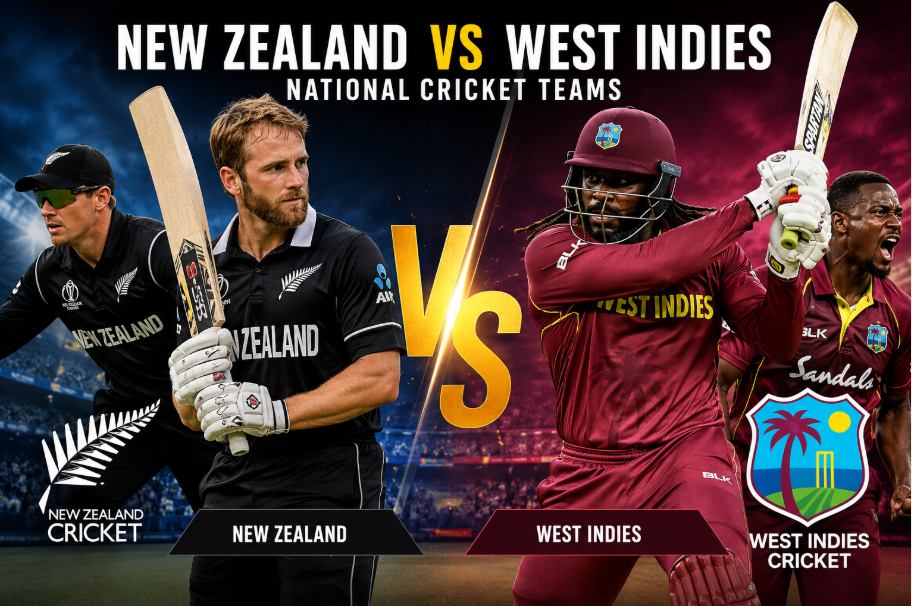
The rivalry between the New Zealand National Cricket Team and the West Indies Cricket Team is one of those cricket stories that does not always get the loudest headlines, but carries deep history and shifting balance. From the early days when West Indies ruled world cricket with fearsome pace and explosive batting, to the modern era where New Zealand’s discipline and tactical clarity changed the contest, this matchup has evolved through decades. Each encounter has produced contrasting scorecards, emotional turning points, and unforgettable individual performances. Fans from both sides have witnessed dominance, revival, and closely fought battles that reflect two very different cricketing cultures colliding on the global stage.
| Date | Match Format | Venue | Winner | Margin |
|---|---|---|---|---|
| Dec 18–22, 2025 | 3rd Test | Bay Oval | New Zealand | By 323 runs |
| Dec 10–14, 2025 | 2nd Test | Basin Reserve | New Zealand | By 9 wickets |
| Dec 2–6, 2025 | 1st Test | Hagley Oval | Match Drawn | |
| Nov 22, 2025 | 3rd ODI | Seddon Park | New Zealand | By 4 wickets |
| Nov 19, 2025 | 2nd ODI | McLean Park | New Zealand | By 5 wickets |
| Nov 16, 2025 | 1st ODI | Hagley Oval | New Zealand | By 7 runs |
| Nov 6, 2025 | 2nd T20I | Eden Park | New Zealand | By 3 runs |
| Nov 5, 2025 | 1st T20I | Eden Park | West Indies | By 7 runs |
| June 12, 2024 | T20 World Cup | Brian Lara Academy | West Indies | By 13 runs |
| Format | Total Played | New Zealand Wins | West Indies Wins | Drawn / Tied / No Result |
|---|---|---|---|---|
| Test | 54 | 19 | 13 | 22 |
| ODI | 68 | 31 | 31 | 6 |
| T20I | 24 | 12 | 7 | 5 |
| Overall | 146 | 62 | 51 | 33 |
| Discipline | Record Type | Player | Team | Stat or Score | Year |
|---|---|---|---|---|---|
| Batting | Highest Test Score | Seymour Nurse | West Indies | 258 | 1969 |
| Batting | Highest ODI Score | Martin Guptill | New Zealand | 237 not out | 2015 |
| Batting | Highest T20I Score | Colin Munro | New Zealand | 104 | 2018 |
| Bowling | Best Test Innings | Sir Richard Hadlee | New Zealand | 6 for 50 | 1985 |
| Bowling | Best ODI Figures | Trent Boult | New Zealand | 7 for 34 | 2017 |
| Bowling | Best T20I Figures | Lockie Ferguson | New Zealand | 5 for 21 | 2020 |
| Match Type | Format | Winner | Score or Margin Details | Year |
|---|---|---|---|---|
| Biggest Win by Runs | Test | New Zealand | Win by an Innings and 134 runs | 2020 |
| Biggest Win by Runs | ODI | New Zealand | Win by 143 runs | 2015 |
| Biggest Win by Runs | T20I | New Zealand | Win by 119 runs | 2018 |
| Closest Match by Runs | ODI | New Zealand | Win by 5 runs | 2019 |
| Closest Match by Runs | T20I | New Zealand | Win by 3 runs | 2025 |
| Closest Match by Runs | T20I | West Indies | Win by 7 runs | 2025 |
The early meetings between the New Zealand National Cricket Team and West Indies Cricket Team set the foundation of a rivalry built on contrast. West Indies entered as a global powerhouse with fearsome fast bowlers and destructive batting depth, while New Zealand relied on discipline, seam accuracy, and patience. The first Test and ODI clashes showed uneven scorecards, yet the Kiwis refused to be intimidated. Even when West Indies dominated, New Zealand’s lower order resistance often frustrated them. Crowd energy in Caribbean stadiums added pressure, but New Zealand slowly earned respect through persistence and tactical resilience. These early matches were not just about results, they shaped the emotional intensity of future encounters, where every wicket and partnership carried historical weight.
| Season | Match Format | Score Summary | Winner | Key Performance |
|---|---|---|---|---|
| 1972 | Test | WI 400+ vs NZ 200+ | West Indies | Clive Lloyd century |
| 1975 | ODI | WI 250+ vs NZ 180 | West Indies | Andy Roberts 4 wickets |
| 1979 | Test | WI 350 vs NZ 300 | West Indies | Glenn Turner 120 |
| 1980 | ODI | NZ 220 vs WI 221 | West Indies | Viv Richards 90* |
During the late 1970s and 1980s, the West Indies cricket machine reached its peak, and the rivalry became a battle of survival for New Zealand. The Caribbean side’s pace quartet consistently dismantled batting lineups, while their middle order produced explosive innings. Matches often felt like one-way traffic, but New Zealand showed glimpses of resistance through long defensive innings and tight bowling spells. Despite heavy losses, the Kiwis learned to adapt to hostile conditions, especially on fast, bouncy pitches. West Indies, however, maintained psychological dominance with aggressive field settings and relentless pace attacks. Scorecards from this era reflect large margins, but they also highlight New Zealand’s growing grit under pressure.
| Season | Match Format | Score Summary | Winner | Key Performance |
|---|---|---|---|---|
| 1983 | Test | WI 450 vs NZ 220 | West Indies | Malcolm Marshall 6 wickets |
| 1985 | ODI | WI 280 vs NZ 190 | West Indies | Gordon Greenidge 110 |
| 1987 | Test | WI 500 vs NZ 310 | West Indies | Richie Richardson 140 |
| 1988 | ODI | WI 260 vs NZ 240 | West Indies | Courtney Walsh 3 wickets |
The 1990s and early 2000s marked a turning point where the New Zealand National Cricket Team began transforming into a structured, tactical unit. Under disciplined leadership, New Zealand focused on swing bowling, sharp fielding, and middle-order stability. Meanwhile, the West Indies Cricket Team entered a transitional phase, losing some dominance but still producing match-winners. This period saw closer scorecards and more competitive ODI encounters. New Zealand’s bowlers exploited conditions smartly, especially in home series, while West Indies relied heavily on individual brilliance rather than collective consistency. Matches became unpredictable, and momentum swings defined the rivalry. For the first time, New Zealand began winning series rather than just individual games, signaling a major shift in cricketing balance.
| Season | Match Format | Score Summary | Winner | Key Performance |
|---|---|---|---|---|
| 1994 | ODI | NZ 240 vs WI 230 | New Zealand | Chris Cairns 75* |
| 1996 | Test | NZ 320 vs WI 310 | New Zealand | Shane Bond 5 wickets |
| 1999 | ODI | WI 260 vs NZ 265 | New Zealand | Stephen Fleming 88 |
| 2002 | Test | WI 350 vs NZ 340 | West Indies | Brian Lara 150 |
Whenever the New Zealand National Cricket Team and West Indies Cricket Team met in ICC tournaments, the intensity increased dramatically. World Cups and global events brought pressure situations where every over mattered. New Zealand’s calm and structured approach often clashed with West Indies’ explosive but inconsistent style. These matches featured crucial partnerships, game-changing bowling spells, and sharp captaincy decisions. New Zealand frequently used tactical field placements to restrict boundaries, while West Indies relied on power hitting to recover from early setbacks. Scorecards from ICC clashes show tight finishes, often decided in the final overs. These encounters significantly shaped the rivalry’s modern identity.
| Season | Match Format | Score Summary | Winner | Key Performance |
|---|---|---|---|---|
| 2007 | ODI WC | WI 190 vs NZ 195 | New Zealand | Daniel Vettori 4 wickets |
| 2011 | ODI WC | NZ 265 vs WI 240 | New Zealand | Ross Taylor 100 |
| 2015 | ODI WC | NZ 280 vs WI 230 | New Zealand | Martin Guptill 150 |
| 2019 | ODI WC | WI 290 vs NZ 295 | New Zealand | Kane Williamson 100 |
The T20 era brought a new dimension to the rivalry between the New Zealand National Cricket Team and the West Indies Cricket Team. Matches became faster, louder, and more unpredictable. West Indies showcased their reputation as the most dangerous T20 batting side with players capable of hitting sixes at will, while New Zealand responded with world-class death bowling and tactical precision. Games often swung within a few overs, and scorecards reflected explosive totals or dramatic collapses. The emotional energy from fans increased significantly, especially during close finishes. New Zealand’s calm finishing ability frequently countered West Indies’ raw power, creating unforgettable endings in global tournaments and bilateral series.
| Season | Match Format | Score Summary | Winner | Key Performance |
|---|---|---|---|---|
| 2012 | T20I | WI 180 vs NZ 175 | West Indies | Chris Gayle 85 |
| 2014 | T20I | NZ 170 vs WI 165 | New Zealand | Brendon McCullum 75 |
| 2018 | T20I | WI 190 vs NZ 192 | New Zealand | Andre Russell 60 |
| 2022 | T20I | NZ 185 vs WI 180 | New Zealand | Devon Conway 92 |
The journey between the New Zealand National Cricket Team and the West Indies Cricket Team shows how cricket rivalries are never static. West Indies once dominated with raw power, pace, and flair, while New Zealand gradually built a reputation on patience, structure, and smart execution. Over time, the gap narrowed, producing thrilling scorecards and high-pressure finishes in ICC events and bilateral series. What makes this rivalry special is not just the results, but the contrast in styles and the respect earned across eras. As both teams continue to evolve, their future encounters promise even more tactical battles, emerging stars, and moments that will add new chapters to this long-standing cricket timeline.